Noe Slideshow

Loading...

Thursday, May 2, 2013

Frank Zappa - Soup, old Clothes and the guitars from Hell


This post inspired by the inimitable Dot Stein (http://www.facebook.com/drdot), who, on 9-19-10 said:

"… had a dream that Dweezil Zappa was putting Frank's face and logo on everything you could imagine: games, clothes, drinks, to make money. I woke up covered in a cold sweat."

Please enjoy the video:
Frank Zappa - Soup 'N Old Clothes


Frank Zappa - Soup 'N Old Clothes - MyVideo

... and my commentary auf Deutsch:

Dieses war ein Photo von meinen guten freund Jon Livzey und auch neben an meinen Projeckt was heisst The Guitar World According to Frank Zappa" Bitte Googlen sie: Doctor Noe's Gadget: Zappa's Inferno – "from an interview first published in Guitar World April 1987 on the occasion of the release of THE GUITAR WORLD ACCORDING TO FRANK ZAPPA distributed by Guitar Galaxy in association with Barking Pumpkin

Zappa by Noe the G. - Guitar World, April 1987
Zappa's Inferno

By Noë the G"

Best little-known Zappa recordings were produced by Noe the G, Founding Editor of Guitar World via Guitar Galaxy as a special audio cassette (remember those?):


Liner Notes from THE GUITAR WORLD ACCORDING TO FRANK ZAPPA
http://lukpac.org/~handmade/patio/misc/guitarworld.html

[Posted to alt.fan.frank-zappa by Dave Lane on March 19 1996 [nostalgic internet message header :)], slightly edited and HTML-enhanced for readabilty and clarity by Bossk (R), and annotated by us and our chosen cast.]

Frank was #19 on my list of top twenty guitarists posted on Dario's wall three years ago(!). The pic on the German-posted video was from my good buddy and collaborator Jon Livzey, and relates to my collaboration with Gail, The Guitar World According to Frank Zappa.


Here is my top ten:

1. 1. Jimi
2. 2. Jeff Beck
3. 3. Jimmy Page
4. 4. Eric Clapton
5. 5. Eddie Van Halen
6. 6. Sandy Bull
7. 7. Elmore James
8. 8. John McLaughlin
9. 9. Jimmy Nolan
10. 10. Carlos Santana
11. 11. Stevie Ray Vaughan
12. 12. Albert King
13. 13. Joe Satriani
14. 14. Mike Stern
15. 15. Jaco Pastorius (bass guitar)
16. 16. Robert Johnson
17. 17. John Lee Hooker
18. 18. Merle Travis
19. 19. Frank Zappa
20. 20. Adrian Belew

and finally, harken back with me to an earlier post on Doctor Noe's Gadget:

FZ in GW April 87 P.2

This illustration is page 2 of my article on Frank Zappa Guitar World April 87 described here:

FZ in GW April 87 P.2

This issue contains my interview with Frank, available in text form at the link below:

Noe G. Zappa Interview Guitar World, April 1987
home.online.no/~corneliu/gw487.htm

Zappa's Inferno

By Noë Goldwasser


FRANK ZAPPA'S FULLY-EQUIPPED HOME RECORDING STUDIO is where he'd most rather be. "I never go out," he says, though his Laurel Canyon home commands a panoramic view of Los Angeles. "I could be just as happy if all this" - gesturing toward the array of equipment that surrounds him in this devil's advocate's workshop-"were in Utah. Except for the fact that the hardware and technicians are available in the L.A. area, and the stuff can be serviced here." The fact is, all Frank really wants to do is work.
Whether he acknowledges it or not, Zappa has been admired by guitarists for years because of the sheer free-flying gonzo-ness of his solos within the otherwise-precise organization of his compositions. He's always been a real Mother of a player. As a bandleader, his draconian insistence on perfection has brought out the best in his players, especially the guitarists he has introduced to the world through his succession of hands: Lowell George, Adrian Belew, Warren Cuccurullo and Steve Vai all cut their teeth in Zappa's marching society.
We thought about this-your editor, Noe the G., and Associate Publisher Greg Di Benedetto-as we descended with Frank into the bowels of his private inferno-otherwise known as the United Muffin Research Kitchen (U.M.R.K.).
Our purpose was to plan the Guitar World According To Frank Zappa tape-a 34-minute collection of rare Zappa solos on a special GW audio cassette which this magazine will make available in the spring-and to talk about guitar stuff.
Well, Frank was perfectly poised to talk about guitar and to play us some of the hours of great solos he has on all those tapes in his vault. But as far as performing on the instrument, we were surprised to discover, the guitar guru has been getting his playing jollies from entering notes and manipulating them with his Synclavier. For various reasons you will hear in his own words in this interview, Frank hadn't played serious guitar in two years (the last recorded example of Frank playing will be available on our Guitar World According To Frank Zappa tape). He'd even lost his callouses!
But fear not, dear reader. Zappa had plenty to say about playing guitar and where the instrument is going. And, believe us, there's reams of guitar in Frank's vaults, which he continues to classify and release to the public as long as the demand is there, through his own Barking Pumpkin organization. The Shut Up And Play Yer Guitar collections did quite well worldwide, so you can expect more to be released in the future.
And we hear that since our talk with Frank, he's been building up his callouses and thinking about going back on the road with his guitar and a band. The moral: you can take the Zappa out of guitar playing, but it'll take a long time to get all the guitar playing out of Frank Zappa.

Noe Gold: Let me get a level on the tape recorder say, "The poodle bites."


Frank Zappa: The poodle chews it.

Noe Gold: Come on, Frenchie! Do you see a conceptual continuum between, say, "Call Any Vegetable" and Shut Up And Play Yer Guitar? Or between the Mothers 0f Invention and the Mothers of Prevention?


Frank Zappa: There are some links, yeah. The main drawback of the medium I'm working in is, until I got the computer I was locked into making music based on the assets and/or liabilities of the guys in the band. In other words, if you want to write something that's faster than what the guys can play, you can't hear it, because they can't play it that fast. Or if you want something for an instrumentation that you don't have in the band, then you won't hear it. But now that I can do it with a computer, that's not a problem anymore.


[read the whole interview here:
home.online.no/~corneliu/gw487.htm

Saturday, April 20, 2013

Yiddish Rock Stars: GEDDY LEE

Mazel Tov, Boychik!

Rush, Heart, Public Enemy and Randy Newman were inducted into the Rock and Roll Hall of Fame last night.

Geddy Lee is really Gary, but his immigrant grandmother (of yiddishkeit persuasion) could only pronounce as Geddy. A tip of the Noe Yarmulkeh to Deborah Frost for that tidbit.

This kinda takes me back to sometime in the late eighties, when I was travelling on a mission from God (or Guitar World anyway). John Swenson was on board to do the interview and I was kibbitzing as the editor.

Geddy and I compared notes on being sons of Holocaust survivors backstage as we waited for the photographer to set up. He in Toronto and me in little old New Yawk shared the same deep roots known as Child of Holocaust Survivors syndrome. Many Yiddishisms were pronounced on that day. And so I say unto you, Geddaleh, Mazel Tov, boychik!


You can see it all in my Yiddish Glossary for Goyim:

boychik (boy-chick) fella [literally, "little boy," but in essence more endearing than derogatory]
"Hey, boychik, meet me at the Grill in Beverly Hills. We'll hoist a few and have some laughs. No agenda, just face time."

baitsim (bayt-tzim) testicles; literally, eggs
"Keep your baitsim in your pants. Last I heard you were a married man."


www.facebook.com/YiddishGlossaryForGoyim
Noë Gold's "Yiddish Glossary for Goyim" is now published as an ebook and a hard copy. The ebook is available from amazon.com, described here:

t.co/q7VAeEhF.

Hard copy: $12 per directly from the author: noemedia@me.com.

Thursday, March 21, 2013

SRV: Cold Shot

SRV by Jonnie Signed-B&W••_50 by Doctor Noe
SRV by Jonnie Signed-B&W••_50, a photo by Jonnie Miles on Flickr.
© Jonnie Miles. From a series of photos taken backstage at Colgate University on April 29, 1988. 

Photographer Jonnie Miles and I were on a road trip as I recall, and the memory is vivid with me as if it were being replayed on some cosmic movie projector.

I was first introduced to the genius of Stevie Ray Vaughan by the writer Bill Milkowski, who championed the plumed genius from Austin in dispatches for this little old magazine I edited called Guitar World. Once he got signed to Epic Records, the SRV Peanut Gallery was taken over by his indefatigable under assistant promo man, Charlie Comer.

Fast-forward to 1988 and by the gracious auspices of Stevie's road manager Skip Rickert, I was standing in the driveway of the upstate New York college waiting for a tour bus to roll in. I was there to greet the man, have a chat and then basically hang out and watch the concert as Jonnie Miles and Milkowski did the reportage heavy lifting. The privileges of editorship.

SRV GW Sept. 1988-BLUES_COV

I climbed up onto the bus and went inside to shake the man's calloused hand. Stevie was gentle and humble, emanating a spiritual equanimity that was not too far from the vibe I'd felt from encounters with some acidheads I'd known who'd been born again. Except the pre-enlightenment breakfast of this champion had been a cocktail of whiskey and cocaine.

SRV looked through me with a clear-eyed gaze. He was proud to tell me of his sobriety, and that is what we talked about for a few minutes more before he went to soundcheck.

The University's people had set up a sort of craft services table in the cafeteria of the Student Union building for the band and crew. I lined up with the band members with my plastic tray to pick up my plate of meatballs and spaghetti. Just ahead of me was Stevie's bass player, a hulking six-footer named Tommy Shannon. As he approached the student volunteer who was ladling out the comestibles, Tommy had a question: "Does this meat sauce have any alcohol in it?"

Only once he was assured that it did not, did he heap his plate with Italian-style food. Everybody in the band, he told me, was on the wagon with SRV, and that extended to even trace amounts of alcohol in food items.

SRV by Jonnie Signed-B&W-Back••_51

That night's concert was the last time of many that I saw Stevie Ray Vaughan perform, drunk or sober. Of course, it was perfect.

Thursday, March 7, 2013

The Jimi Hendrix Biopic Experience: Perpetual Haze

My article in Daily Variety, March 7, 2013:

This is one case where the overly micromanaging Janie Hendrix should have held off. A proper film about Jimi might have resulted. The previous production that she scared off would have been directed by Paul Greengrass (“The Bourne Ultimatum”), a respected and respectful director, and produced by Thomas Tull "(It Might Get Loud"), who would not go forward without the proper music.

That one is now just a castle made of sand.


Noe Gold: Jimi Hendrix Biopic | Variety_3-7-13

variety.com/2013/music/columns/perpetual-haze-encumbers-j...

Variety | COLUMNS | MUSIC
03.07.13 | 04:00AM PT


The Jimi Hendrix Biopic Experience: Perpetual Haze

'All Is By My Side' treads careful path on rights issues, real-life personalities


By Noë Gold

The road to mounting a Jimi Hendrix biopic has been long and winding, frequently stalled by the roadblock that stood in the way — Experience Hendrix LLC, the estate’s tightly controlled rights and marketing organization, whose CEO is Janie Hendrix, the adopted daughter of Hendrix’s late father — without whose cooperation no Hendrix-penned music can be used in a film.

As the saying goes, be careful what you wish for.

“All Is By My Side,” shot last summer in Ireland and current in post, is doing exactly that. With Andre Benjamin (aka Andre 3000) starring as Hendrix, Hayley Atwell as his live-in London love Kathy Etchingham and Imogen Poots as Linda Keith, the film focuses on Hendrix’s pre-stardom period in swinging London. The biopic has not received permission from the Hendrix estate to use any of his music, and some of the guitarist’s associates are fuming that they were left out of the loop.

andre-3000-hendrix1


• André Benjamin with Hayley Atwell (who plays Kathy Etchingham) in a still from "All Is By My Side."


With the help of music supervisor Danny Bramson, who is also a producer, the film is using its cover as an origins story to feature music not written by Hendrix but rather songs by artists including the Beatles, Muddy Waters and Chip Taylor (“Wild Thing”), which Benjamin has recorded for the soundtrack.

You won’t be hearing “The Wind Cries Mary” in this film, and the woman for whom that song was written, Etchingham, is not pleased by the prospect of the film’s release or about how she is portrayed in it. She said she was not consulted about the storyline.

Etchingham said she contacted the filmmakers and offered help but did not get a reply. “I later read in the Independent that Hayley Atwell was playing my character and that I would be portrayed as a ‘wild child’ who swore in every line. I felt that it would not be an accurate portrayal.”

Jimi&Kathy-BrookStreet

• Jimi & Kathy Etchingham in the flat on Brooke Street, London where they lived and which is from her book, "Through Gypsy Eyes"


The article she cites describes Atwell’s account of the movie, in which she commented on playing Etchingham as a working-class Mancunian who was a “chain-smoking wild child” with a “tempestuous relationship with Jimi.”

Etchingham’s reaction: “Firstly, I am not from Manchester. I am actually Irish … my father’s family were prosperous Irish landowners and owned property in Dublin and Wexford. They could not be described as working-class. I am not prone to swear all the time. I was not a ‘wild child’ like other ‘rock chicks.’ My friends used to tell me how sensible I was.

“I don’t know where the screenwriter got this misinformation from. I’m sure a good film could be done about his London days, but it would probably be better in collaboration with people who actually knew Jimi personally, like me and Roger Mayer, Madeline Bell, etc.”

Mayer, the former British Navy engineer and close Hendrix personal friend who has been credited with co-creating the guitarist’s signature sound, noted that scenes in the film seem to depict Hendrix as a domestic abuser. “It seems these naughty filmmakers haven’t researched anything properly,” he said.

It has been 43 years since Jimi Hendrix died at the age of 27. To date, only documentaries, such as 1973’s “Jimi Hendrix,” which features the real personalities and live performances of the people in Hendrix’s life, including his father, Al Hendrix, Mick Jagger, bassist Billy Cox and Eric Clapton, have been produced.

Laurence Fishburne was close to mounting a biopic in 1993 based on the David Henderson biography, “‘Scuse Me While I Kiss the Sky” with himself in the title role. But since he could not use Hendrix’s music, the pic never got made. Since then, prospective projects featuring Eddie Murphy, Will Smith and even Prince have failed to cohere.

The most recent project to have tried and failed was a Legendary Pictures effort in 2011 with director Paul Greengrass (“The Bourne Ultimatum”) attached. But because the estate would not give Legendary topper Thomas Tull its blessing to use Hendrix songs such as “Foxy Lady,” “Voodoo Child” and “Purple Haze,” Tull opted not to proceed.

Janie Hendrix had this to say at the time: “When we do the Jimi Hendrix feature film bio, we will be involved and in control from the beginning.”

Representatives from Experience Hendrix did not respond to requests for comment.

FILED UNDER: HAYLEY ATWELL; JIMI HENDRIX; KATHY ETCHINGHAM

© Copyright 2013 Variety Media, LLC, a subsidiary of Penske Business Media, LLC. Variety and the Flying V logos are trademarks of Variety Media, LLC.

___________________________
Jimi-JimMarshall-MontereyPop_4078-31-SURPRINT

Kathy Etchingham BBC interview:


Kathy Etchingham book:
www.kathyetchingham.com/


To read about Montagu Square click on the link below.
www.kathyetchingham.com/34-montagu-square/


Roger Mayer's page:
http://www.facebook.com/rogermayerfx
rogermayerfx/

To read more about Roger - click on the link below.

www.kathyetchingham.com/roger-mayer-and-jimi-hendrix/
http://www.kathyetchingham.com/roger-mayer-and-jimi-hendrix/www.bbc.co.uk/news/magazine/

Saturday, February 9, 2013

Experience Music Project Hardhat Tour April, 2000

This is from a hardhat tour I took of the Experience Music Project in Seattle as it was nearing completion April, 2000.

Note the Guitar World Special Issue Sept. 1985, edited by yours truly, Noë the G.

I wrote about it in this article, which was syndicated by the BPI Newswire but has somehow disappeared from cyberspace. Now it's back.


Experience This / A first look at Paul Allen's ambitious rock'n' roll temple

The Hollywood Reporter
June 13, 2000

By Noë Gold
All photos by Noë Gold

The high walls of the Sky Church are rumbling, literally shaking with a presence that is not of this Earth.

On the physical plane, the cavernous exhibition hall sits in Seattle, a few yards from the terminus of the monorail that links the city's downtown to its monolithic Space Needle.

On the spiritual plane, Jimi Hendrix, the avatar of guitar-driven rock 'n' roll who first asked "Are You Experienced?" is very much in the house -- a gleaming, new house that media mogul Paul G. Allen has built to honor popular American music.

The Sky Church is the spiritual centerpiece of the soon-to-open Experience Music Project, a massive museum designed by famed architect Frank O. Gehry to enclose 140,000 square feet of free-flowing, music-related exhibits on a 35,000 square-foot plot of land carved out of the city's once-grand Seattle Center.

The references to the Seattle-born Hendrix are intentional. The museum's mission, its founders say, is to have people experience the music. Come June 23, the first paying guests will find out what's going on inside the twisted, sky blue and magenta-hued piece of architecture that has been under construction since 1997.

The Sky Church concept is taken from one of Hendrix's dreams, in which he described a place where all diverse people could come together to appreciate music. The space fulfills Hendrix's prophecy by doubling as a grand exhibition hall by day and a performance space at night.

The EMP itself can be described as a museum with aspects of a theme park, through which people will take a "ride" amid the cultural artifacts that celebrate the blues-based, soul-inflected, rockabilly roots of American music.

More than 800,000 are expected to visit the nonprofit facility each year, with top ticket prices set at $19.95.

The museum opens with a party that will include musical performances by James Brown, Metallica, Red Hot Chili Peppers, Eminem and Snoop Dogg, Alanis Morissette, Eurythmics and Bo Diddley. MTV and VH1 will televise much of the hoopla.

Jody Patton, the EMP's co-founder and executive director and Allen's sister, dates the museum's genesis to 1992, when she and her brother attended a Sotheby's auction of rock 'n' roll memorabilia.

"Paul was intrigued by the artifacts," she says, "and we did the bidding. When the pieces arrived, we gingerly unpacked these things and we were in awe of how the spirit of the person who used them becomes imbued in the personal article. Paul said, 'If I think this stuff is really neat, then other people will be moved as well.'"

In Allen's longhair days, he played a Fender guitar. The obsession continues, except today Allen owns the Stratocaster that Hendrix played at Woodstock in 1969. And a whole lot of other stuff -- 80,000 artifacts, in fact, now reside here. More than 1,200 of them will be on display at at any given time.

The EMP's Hendrix Gallery enshrines the contract signed by the musician for Woodstock, revered objects of Hendrix's outrageous clothing and Allen's version of pieces of the cross: fragments of a guitar Hendrix smashed and burned at 1967's Monterey International Pop Festival.

The Guitar Gallery gives museum-style prominence to artifacts of rock like an early electric lap steel guitar, a Gibson Flying V prototype and axes played by the likes of the Byrds' Roger McGuinn and bluesman Tampa Red. There is a trumpet from Quincy Jones' early days in Seattle and song lyrics by another Seattlite, the late grunge rocker Kurt Cobain. Bob Dylan's harmonica and Janis Joplin's pants are there, too.

A recent hard-hat tour reveals EMP is no mere memorabilia collection. Flat-screen monitors and interactive displays are everywhere. A snaking corridor leads to the "Crossroads" exhibit, the main exhibition area, where disparate musicians like Hendrix, hip-hop and Bing Crosby meet via multimedia.

Patrons can also wander into hands-on personal studios, where they can try their hands at keyboards, drums and guitars.

The facility is truly wired, with organizers especially proud of the flooring itself, a raised platform made of modular concrete slabs that can be removed and bolted down to give technicians access to miles of high-definition optical cable and ISDN lines.

Via a modular data processing unit called a MEG, visitors can zoom in on various exhibits and receive data about what they are seeing. They can then download bookmarks that may be accessed later.

In researching his designs for the building, Gehry visited a music store and looked at guitars, bringing some home and deconstructing them. "It's not supposed to be a smashed-up guitar," says EMP's design and construction project manager, Paul Zumwalt, who created the Portland Trail Blazers' Rose Garden basketball arena, another Paul Allen edifice. "It's about the spirit of the music, with its flow and movement."

Originally, the monorail was supposed to stop short of the building. But when Gehry saw that the monorail bisected the site, he began to play.

Allen and his sister wanted an architectural design that "could literally express the way we respond to the music." And the music she was describing is anything but conventional. Allen used the word "swoopy."

Swoopy is what they got. There is not a right angle in the place. Neighbors who watched the building come together were mystified by what looked like a jumble of curved metallic sections reaching up into the sky.

"What appealed to me about Frank," Patton says of the architect," was his commitment to exploring the process. ... His designs go to a new place aesthetically -- the curves. It is a living, moving, organic thing."

Kind of like Electric Ladyland.


Saturday, December 29, 2012


Memo to The Buddha Diaries


Peter Clothier is an author and a scholar whom I respect. I posted this comment on his exemplary The Buddha Diaries Blog in order to make a point about my own humble scribblings.


Peter, I have published a book today as well. I was hoping you'd have a look-see (only $4.99, cheap, as the fershlugginer editors of Mad magazine used to say) and perhaps write me up a nice testimonial so I could help spread the word about it. I really am proud of it.


http://www.amazon.com/Yiddish-Glossary-Goyim-Shmoozers-ebook/dp/B00ATEDIOM/ref=sr_1_1?ie=UTF8&qid=1356583363&sr=8-1&keywords=Yiddish+Glossary+for+Goyim


Tuesday, December 4, 2012

Cameron Crowe-Patrick Fugit

From an article in The Hollywood Reporter, September 12, 2000:

caption:
Crowe with his “Almost Famous” star Patrick Fugit

Crowe’s Nest
FILM FESTIVAL BECOMES ALMOST FAMOUS FOR ITS 25TH ANNIVERSARY

By Noë Gold

Director Cameron Crowe presented his poetically autobiographical “Almost Famous” to the Toronto International Film Festival at a world premiere gala screening in the Roy Thomson Hall September 8. It is the story of how Crowe began his career as a rock writer at the tender age of 16. The movie is highly accurate in the cultural details, while the names of most of the film’s characters have been changed to protect the innocent, or the guilty, which in the film’s early-’70s universe was often a relative question. Crowe sat down with The Hollywood Reporter features editor Noë Gold, who crossed paths with Crowe years ago: When Crowe’s infamous Rolling Stone cover story on the Allman Brothers Band appeared, Gold was the music reviews editor of another “rock rag,” Crawdaddy.

THR: How does it feel to be a cultural hero?

Cameron Crowe: You know, all I wanted to do with the movie is not make one of those self-glorification, golden haze kind of fiction pieces. I thought, you know, non-fiction is the way to and if you can’t do a documentary which is usually gonna be the best way to see rock on a screen, but be true to the way the music makes you feel, and that’s more important than the glory of me— [postures] “Well you know when I was on the road with Lee Michaels” — you know you don’t want something unseemly about it all but if you can catch what it is the be a fan and celebrate it. [for the rest of the article, go to doctornoemedia.blogspot.com]

Like I’m always so proud — even though I know the movie traditionally I think the structure of the movie .. you wouldn’t have that scene with Fairuza Balk talking about what it is to be a fan? If you cut that scene, you have no movie.


THR: To me the transitions are the first of the hallmarks of your style that I recognize and really enjoy. For instance, when the band ditches the tour bus to switch over to travelling by airplane. There’s a cut right there and on the soundtrack we here Jimi Hendrix’s “Voodoo Child” — cranked up guitar that really makes a comment about the sequence.

Crowe: Yeah, yeah.

THR: Speaking of Hendrix, you use a visual reference when we enter [kid character’s] room, we see a big poster of the Jim Marshall photograph of Jimi staring at us. What struck me was the artifacts, the visual details you have so painstakingly created. That’s the second hallmark that so impressed me. Your use of detail as iconography. The first time I watched the movie, I let it wash over me. The second time, at last night’s (9/8? Check) screening, I just got off on the details. And what strikes me is the rights and permissions work you must have to go through.

Crowe: Yeah, we fought hard for that [permission to use the song “”Voodoo Child”]. That was the toughest one to get. We had to beg quite a bit. They [the rights holders] did not want to give it to us because these days anything with perceived sex and drugs they don’t want associated with Jimi Hendrix.

It’s amazing. I mean, some of those car ads are more pornographic than movies that glorify decadence in rock. But still, whatever man, if they are able to keep Hendrix’s legacy alive however they do it is just fine. But (laughs) don’t draw the line at me!

THR: Now, the planned companion DVD that you were talking about at the press conference today, could you tell me how that would look in terms of ancillary music that might be put on there, as opposed to ancillary video that would be put on there. And are you going to shy away from it because of rights and permissions issues, or would that be a crux move for you in terms of positioning this DVD?

Crowe: We had a lot of material that didn’t make it into the movie — the version that is going out into the world. The longer version is indulgent — hopefully gloriously so — and there’s a lot of stuff that deserves to be seen, but . … Whenever I see a collection of deleted scenes, it begs you to watch that and go … “I don’t know why they used that. I would never use that. What is that?”

THR: It’s not just some “Easter Eggs” you’re talking about here? Sounds like a special version of the movie on a DVD.

Crowe: This [the special DVD Crowe is planning to release] is a whole cut of the movie, a different, fatter cut. It’s about two hours and 45 minutes, something like that and it has the full Stillwater [the fictional band that Patrick Fugit’s character follows around in the movie]concert stuff. It has Frances McDormand listening on the phone as her son plays [Led Zeppelin’s] “Stairway to Heaven” in its entirety, and you at home have to put on “Stairway to Heaven.” It freeze-frames. It’s not interactive material.

But the DVD version of that scene will just have the longer version and because Led Zeppelin will never sell the rights to “Stairway to Heaven,” you at home get to supply it.


THR: Early in the movie, Frances is walking with her two kids and there’s a movie marquee in the background that shows two movie titles — Francois Truffaut’s “Stolen Kisses” and the D.A. Pennebaker Bob Dylan documentary “Don’t Look Back.” Was there a thematic reason for those two movie titles?

Crowe: Yeah, in fact. Both of those movies probably had an equal effect on “Almost Famous.” “Stolen Kisses” just for the beautiful light touch that masks the deeper pain and anxiety and lost love. And “Don’t Look Back” because it’s just corrosive and real. And they would have snippets of live shows that were just great. You could barely get a hand on them and they were gone.

As far as a rock movie that isn’t a documentary, I would go with “Quadrophenia.” “Quadrophenia is probably still the best rock movie that isn’t a documentary.

THR: There’s another scene in the movie that shows your attention to detail. There’s a flash cut to a marquee of Max’s Kansas City, the legendary New York club where so much decadent rock history unfolded in the ’70s — and doesn’t exist today. You recreated the club for a party scene, but the lighting was not like I remembered it. It wasn’t dark and cavernous, with red booths and Dan Flavin flourescent-light sculptures. It was a daytime party. A record industry party with beer bottles and messiness. And that art direction was intentional.

Crowe: Exactly. The scene was “Let’s get to Max’s.” Plus we wanted Kate Hudson’s character, Penny Lane to run across town to the Plaza hotel with a little bit of light in the sky.

THR: Where something more dramatic will happen.

Crowe: It just seems sadder that she would do that with some light still in the sky. It’s so cool that you see the details like that.


THR: Once again, god is in the details. I saw the movie two weeks ago and it took me on a time trip. I let it wash over me. Last night, I noticed the film’s rhythm, which takes you into the world of these strange-looking rock and rollers. Gradually, as you keep watching, you go back to the ragtag days of 1974. And all the visual cues are right.

Crowe: . I love what [cinematographer] John Toll did so much. There’s a lot of beautiful work there.

The movie is about music. It really is from the heart. I always love the albums and this was attempting to be part of the tradition. But it’s a ,musical tradition that was fun. Fun is good. And it is about music that is “ultimately righteouosly dumb,” as [the late rock critic] Lester Bangs said.

THR: Tell me about the time when Greg Allman freaked out on you.

Crowe: We were on the road for a couple of weeks with the Allman brothers and the night before I went home he had a vision that I might be a cop, and called me up to his room and asked for all the tapes. And this was my first cover story for Rolling Stone. And I was scared. And I gave him all the tapes. I never told Ben Fong-Torres [Crowe’s editor at Rolling Stone, who is depicted in the movie].

I got them back in the mail later and [legendary Allmans manager] Phil Walden called me up and said, “Hey, Cameron Greg woke up in Hawaii with your tapes and uh, you know the brothers sure did like you on the road. Hope everything’s fine and Greg sends you his love and … “

I was just happy to get my tapes back and to just do my story. And I knew if I told Ben about that… I just kept it under my hat and wrote the story.

Years later Neal Preston was shooting Greg for People magazine and Greg said, “Hey whatever happened to that kid that came on the road with you and the band?”

Neal says, “Well the guy’s making movies now. He’s doing this movie about rock right now.. He made ‘Jerry Maguire’ ”

Greg says, “Great. Boy, we really put that kid through the ringer.” That’s what he remembered. And it’s funny how so much of that informed what ther movie was. Cause they put me through the wringer. But I was happy to be in the wringer, Wrenched out.

THR: We could go on reminiscing about those rock and roll days of the ’70s, but people can see the movie for that. Would you answer one question we have about the future? You have a [Tom] Cruise/ [Penelope] Cruz project coming up next, don’t you? What can you tell us about that?

Crowe: Not much, but it is called “Vanilla Sky ”— which is kind of a musical title, and I’m happy about that — and it’s a. contemporary love story set in New York. It’s Cruise, Cruz and Cameron Diaz.

THR: And when do you start work on it?

Crowe: We start at the end of next month. Yeah, I’ll be full of energy by then [laughs]. I’ll be anxious to get out there and do it again.

Tuesday, November 20, 2012

jimi_jams

jimi_jams by Doctor Noe
jimi_jams, a photo by Doctor Noe on Flickr.

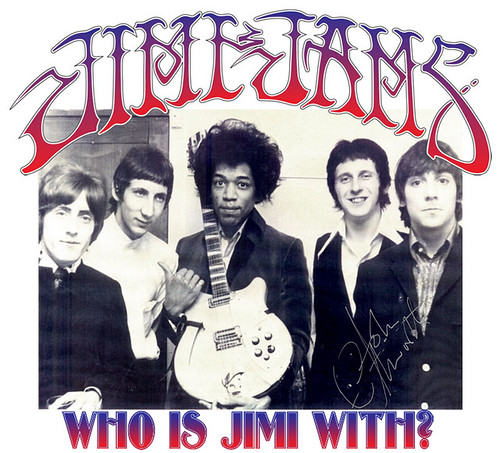
Hendrix arrived in London in 1966 under the wing of new manager Chas Chandler, and he was treated like royalty forthwith. At the time, the Beatles and the Stones were the reigning rock royalty, Beck and Clapton, the guitar kings and The Who endowed with the most flamboyant stage act.
 
All of these came to visit when Chandler arranged for Jimi's society "coming out," the first to be converted being Clapton, when Hendrix jammed with him on a version of "Killing Floor" at a Cream gig. The rest followed after a slew of barn-burning club appearances. The Who had a connection to Hendrix by virtue of the fact that the group's managing team of Kit Lambert and Chris Stamp also owned Track Records, to which they aspired to sign the Experience.

Pete Townshend said at the time that he feared, "Oh God, Kit Lambert has found another guitar player." Then, in a packed London theater, Hendrix put the icing on it, making him a dangerous act to follow: He burned his guitar at the end of the set, causing absolute mayhem.

This was not lost on The Who, who previously had been famed for other, less incendiary stage antics, such as the simple destruction of a Rickenbacker guitar. At Monterey a little while later, the question of who was to follow Who came up again. The Who won the coin toss, in an effort to not repeat the debacle of the London Savile Theatre show in which Hendrix had wiped them out even before they hit the stage, they tore it up.

But Hendrix was not to be outdone. He followed The Who with a set of pyrotechnics climaxed by the burning of the midnight Strat.

Jimi&TheWho_GW-PromoSticker

http://www.flickr.com/photos/doctor_noe/6387446891/in/set-72157605512202079

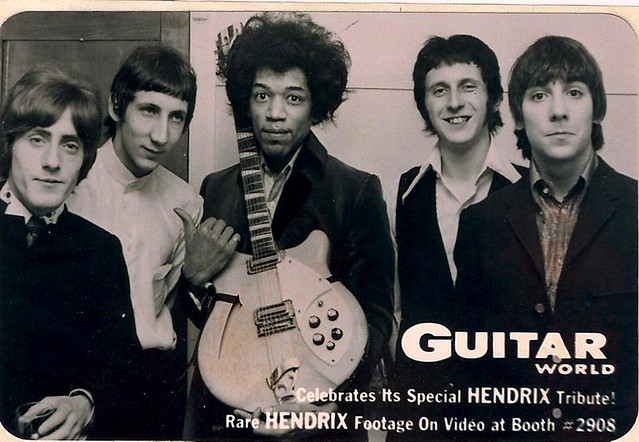
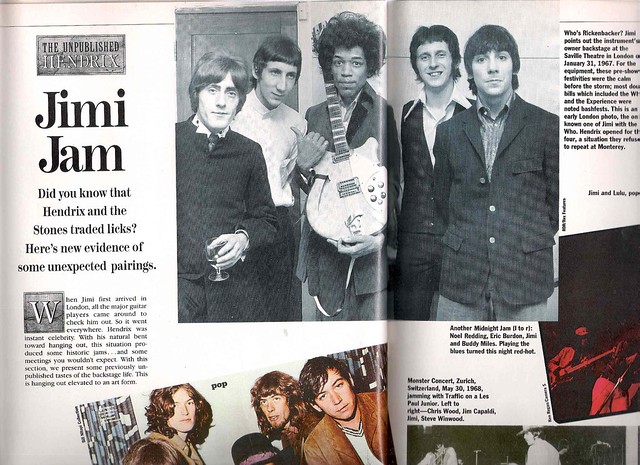
Jimi & The Who, original pic by Barry Peake, used here on a promo sticker (and a tee-shirt) promoting the Guitar World "Unpublished Hendrix" special issues.

www.flickr.com/photos/doctor_noe/2567714905/in/set-721576...

November 27 is Jimi's birthday!


www.ebay.com/itm/110978082253?ssPageName=STRK:MESELX:IT&a...

Monday, October 29, 2012

Clapton's Beano Period

I have commented before about this Clapton session. You can see a print of Slowhand from February, 1966 on this pic clipped to the strings of a Les Paul guitar, which was staged as Guitar World's Collectors Choice Centerfold Honoring the Marshall "Bluesbreaker" 2x12 50-watt combo Model 1965340.

BluesbreakerBeano w text

The amp – the Marshall "Bluesbreaker" 2x12 named for the album on which it was used – was found for me by the honorable Steve Melkisethian of Angela Instruments in Laurel, Maryland (Steve later got me the "Bullet" harp mike dedicated by Billy Gibbons to me, and which I still use, but that is another story). I orchestrated the whole setup in the studio for GW "Guitographer" Glen La Ferman's loving homage. The amp is owned by Mike Doyle of Guitar Center in CA.

Of the amp, Pete Prown, Gear Editor of Vintage Guitar magazine, said recently, "This is Ground Zero for rock-guitar tone. This is when it all exploded ... Hendrix, Beck, Cream, Zep -- they all took their cues from the Bluesbreakers album, tone-wise. It wasn't fuzz. It was TUBE tone."

Here's some more fab facts about Beanos, Bluesbreakers and that guy they used to call God:

Blues Breakers is an album credited to John Mayall With Eric Clapton, released in 1966. It peaked at #6 on the UK chart. In 2003. The album was ranked number 195 on Rolling Stone magazine's list of the 500 greatest albums of all time. Apart from being one of the most influential blues albums, it also started the now-legendary combination of a Gibson Les Paul guitar through an overdriven Marshall Bluesbreaker amplifier.

The band name John Mayall & the Bluesbreakers is derived from the title of this album; no original issues mention the Bluesbreakers as band name. The album was also known as The Beano Album because of its cover photograph showing Clapton reading The Beano, a British children's comic. Clapton stated in his autobiography that he was reading Beano on the cover because he felt like being "uncooperative" during the photo shoot.

Originally, John Mayall intended for his second album to be a live album in order to capture the guitar solos performed by Eric Clapton. A set was recorded at the Flamingo Club, with Jack Bruce (with whom Clapton would later work in Cream) on bass.

The recordings of the concert, however, were of bad quality and were scrapped. With the original plan of a live album now discarded, John Mayall & the Bluesbreakers recorded Blues Breakers with Eric Clapton at Decca Studios, West Hampstead in March, 1966. The guitar that Eric Clapton used during the sessions was a 1960 Gibson 'sunburst' Les Paul with two PAF (Patent Applied For) 'humbucker' pickups.

This guitar, whose whereabouts are currently unknown, is also known as the "Beano" Les Paul, a replica of which has recently been reissued by Gibson.

Wednesday, October 24, 2012

Jamie Lee Curtis Returns to the Scene of the Sublime

So, it is Halloween again and this news deserves a blog update. In honor of Debra Hill, the producer (R.I.P. 2005), who used to be my next-door neighbor ...
... I will make this the basis for a new blog update 2012!!!

The new poster for the re-release:
halloweenposter_LAT_10-24-12 last year's blog ...
Fear of Fright Night (redux):
and lest we forget ... Fear of Fright Night redux: http://doctornoemedia.blogspot.com/2011/10/just-in-time-for-halloween.html
Just in time for

Halloween ...


... my updated essay on classic horror films entitled “Fear of Fright Night.” Wrote the original in 2001 for an AOL site called Entertainment Asylum. Find the page here. I wrote numerous pieces for Entertainment Asylum in my tenure as an AOL correspondent/content editor, but only this one was saved for posterity.

Flashforward to 2010, and I can now put up this considered reprise, recollected in tranquility entitled ...

FEAR OF FRIGHT NIGHT (redux)

Halloween Goes to the Movies

Watching Scary Movies in the relative safety of a theater with hundreds of other people around us will not turn us into raving, bloodthirsty lunatics. On the contrary, it's a cheap alternative to seeing a shrink.


By Noë Gold
We are now in the midst of another cycle of shock films, loosely categorized by film historians as the horror genre but I'll just call 'em Scary Movies, since these film historians tend to quarrel and quibble about what exactly is a horror film. I say "cycle" because these films come in bunches, about every twenty years or so, and are extremely popular. The films in the late-'90s crop (typified by "Scream," "Scream 2," "I Know What You Did Last Summer," "Disturbing Behavior", the latter-day "Halloween: H2O" and the equally sequel-tastic "I Still Know What You Did Last Summer") have one thing in common: they're not "monster movies" like "Frankenstein" or "The Fly" or any of the creepy horror films that were popular in the fifties.


1530 North Orange Grove Ave. across the street stood in for the Doyle residence, where Laurie was baby-sitting Tommy in "Halloween." Looking the same as when the movie was filmed there 30 years ago, except the brick pillars in the front are filled in with hedges. The panicked children ran from the house between the pillars and onto the street. Photo by Noë Gold

The Scary Movie of the nineties relies more on psychological terror than the obvious makeup-enhanced movies of that more innocent era. It deals with ordinary people in ordinary situations who come across a deviant like "Halloween's" Mike Myers. The suspense in H20 is more on account of the audience's expectations and the throbbing, spooky music than from any obvious monster. Mike Myers comes with a lot of baggage, and it's all hidden beneath that very ordinary white Halloween mask. The effect is much more chilling than Godzilla or Keith Richards could ever hope to be.

Why is this Scary cycle surfacing again now? On the surface, things are fairly stable in modern-day society. Crime statistics are down, the economy is whistling along and Charles Manson is tucked away neatly in prison with no hope of escape. So why do we flock to movies that scare the gizzards out of us? Because it gives us pleasure. When there are no real things to be scared of, we go to the movies to shake things up. In a weird way, it's therapeutic.

To illustrate this point, I call forth a reference in a seminal book by an author I used to know who taught me a lot about the genre, Carlos Clarens. On the frontispiece of his Illustrated History of the Horror Films, Carlos quotes sociologist Roland Penrose from his work, Violence in Contemporary Art: "The bogey of violence is particularly horrifying and intolerable to us when we meet it in cold blood. The arts, however, avoid its brutal impact by their appeal to the emotions, they warm us to its presence, turning terror into enjoyment and cruelty into compassion. We participate in the act of violence without suffering its evil consequences. Art, in fact, allows us, as in certain rituals, to satisfy our Olympian yearning to stimulate the forces of nature. Its nonviolent power has a therapeutic and catalytic influence."

So, watching Scary Movies in the relative safety of a theater with hundreds of other people around us will not turn us into raving, bloodthirsty lunatics. On the contrary, it's a cheap alternative to seeing a shrink. For the same reason we pay money and wait in long lines to ride the shriekiest roller coaster, we go to the movies to get our hair lifted. Steve Miner, who directed H20, says it this way: "My favorite scary film of all time was Psycho, which I could not sit through. I never saw the whole movie until I was an adult. Halloween I found reminiscent in spirit of that kind of movie: unrelentingly scary and suspenseful and atmospheric. I think people like to be scared because they can go to the edge without really being there."

Kevin Williamson, the Dawson's Creek director who wrote the screenplay of H20 as well as that of Scream, credits Halloween for what he is today. "Halloween is and always has been my favorite film of all time," he says. "It wasn't just a movie, it was an experience. ... The audience participation factor was one of the most incredible parts of the movie. The way the audience jumped and screamed at the characters on screen got my blood pumping. It was this effect in Halloween that made me realize that I wanted to be a filmmaker.

Okay, what about that "every twenty years" theory? It's no coincidence that the current Halloween is subtitled H20, since the original Halloween was released in 1978. That one put its director, John Carpenter, on the map and kicked off the career of Jamie Lee Curtis as well (it was her first feature film). H20 has among its co-stars Jamie Lee's mom, Janet Leigh, who was the star victim of Alfred Hitchcock's Psycho, released 18 years before Halloween in 1960 (and later to be redone in a faithful translation by Gus Van Sant). Carpenter's stated purpose in conceiving Halloween was that he wanted to create a picture that would play like a full-length version of the shower scene in Psycho.

Go back roughly twenty years from Psycho and you have the beginning of another Scary cycle in the early forties. A series of films produced by Val Lewton has a lot in common with what the Scary cycle of the nineties is going for - psychological horror with no monsters or creatures in sight. The great director Jacques Tourneur did more with camera angles, lighting and sound to chill the audience's bones with his masterpieces the original Cat People and his follow-up I Walked With a Zombie. I command you to go out and rent these right now so you can see what I mean.

The first of these twenty-year cycles, just to round out my argument, goes back to Germany in the twenties. You won't be able to rent Paul Weggener's Student of Prague or his series of films about the Golem, a vengeful Jewish monster who haunted Czechoslovakia. But there is also The Cabinet of Dr. Caligari and F.W. Murnau's Nosferatu, the original vampire story (with Max Schreck as the Vampire). And rounding out the cycle is The Hands of Orlac, with Caligari's Conrad Veidt, about a concert pianist who has the hands of a murderer grafted on after he loses his in an accident. The fright genre moved (along with a number of German filmmakers escaping the Nazis) to America for its next cycle, and it is also no great coincidence that another one of these German exports, Peter Lorre, made his American film debut in 1935 in a remake of Orlac called Mad Love, another one that you must rent or seek out on cable TV.

Which is all to say that what comes around goes around in the world of roller coasters and Scary Movies. Now that I have given you a quick sense of its history, it's a good time to grab a ride.


PS, there’s also a neato keeno compendium of creature features here on the same site:

http://www.angelfire.com/ma/babybrownsplace/articles/articles.html

.... and in this photo gallery from The Hollywood Reporter:

also ...


LA Times 10-24-12

‘Halloween’: John Carpenter classic returns for theatrical run
Oct. 24, 2012 | 6:00 a.m.

Michael Myers, the masked silent Shape that emerged from the shadows of Haddonfield, Ill., to stalk generations of moviegoers, will return to theaters Thursday for a re-release of John Carpenter’s landmark 1978 horror film “Halloween,” just in time for the Oct. 31 holiday.
Trancas International Films, in partnership with Compass International Pictures and Screenvision, will open “Halloween” in roughly 560 theaters in the U.S. and more in the United Kingdom this week, marking the widest release the film has had since its original run.
With the 35th anniversary of “Halloween” arriving next year, it seemed the right time to resurrect Carpenter’s classic in a proper theatrical setting, according to Justin Beahm, Trancas’ vice president of licensing and new media. …..
……….

“He isn’t a destination creature,” Beahm said. “In ‘Jaws,’ the shark’s only a threat when you’re in the water. In so many films, you have to venture into the darkness or into the mysterious whatever to find the creature. Michael exists in the shadows in our own homes. He’s in the closet. That never goes away, that’s always going to be relevant to people and there’s a real timelessness to it.”
– Gina McIntyre
@LATHeroComplex


Weho Houses' Spooky 'Halloween' History
Scenes from John Carpenter's visionary 1978 film were shot on North Orange Grove Avenue.
By Noe Gold
October 29, 2010

Short URL: patch.com/A-RbW

… and speaking about Halloween, this piece is a perennial:
Fear of Fright Night
Why the current crop of horror films holds no candle to the original masters
By Noe Gold
www.angelfire.com/ma/babybrownsplace/articles/art7.html

Monday, October 1, 2012

Ballad of a thin man

Ballad of a thin man by Doctor Noe
Ballad of a thin man, a photo by Doctor Noe on Flickr.
A magic quote from Mikal Gilmore's califragilistic interview (Bob Dylan Rolling Stone cover story Sept. 27, 2012) comes at the end with a reference to Dylan's supposed nod to the Civil War poetry of Henry Timrod. This is so Zim:

"Oh yeah, in folk and jazz, quotation is a rich and enriching tradition. That certainly is true. It's true for everybody, but me. I mean, everybody else can do it but not me. There are different rules for me. And as far as Henry Timrod is concerned, have you ever heard of him? Who's been reading him lately? And who's pushed him to the forefront? Who's been making you read him? And ask his descendants what they think of the hoopla. And if you think it's so easy to quote him and it can help your work, do it yourself and see how far you can get. Wussies and pussies complain about that stuff. It's an old thing – it's part of the tradition. It goes way back. These are the same people that tried to pin the name Judas on me. Judas, the most hated name in human history! If you think you've been called a bad name, try to work your way out from under that. Yeah, and for what? For playing an electric guitar? As if that is in some kind of way equitable to betraying our lord and delivering him up to be crucified. All them evil motherfuckers can rot in hell."

Sunday, July 15, 2012

Jimi & The Who Guitar World PromoSticker

Jimi&TheWho_GW-PromoSticker
OK, so there's a story behind this piece. Hendrix arrived in London in 1966 under the wing of new manager Chas Chandler, and he was treated like royalty forthwith. At the time, the Beatles and the Stones were the reigning rock royalty, Beck and Clapton, the guitar kings and The Who endowed with the most flamboyant stage act.

All of these came to visit when Chandler arranged for Jimi's society "coming out," the first to be converted being Clapton, when Hendrix jammed with him on a version of "Killing Floor" at a Cream gig. The rest followed after a slew of barn-burning club appearances. The Who had a connection to Hendrix by virtue of the fact that the group's managing team of Kit Lambert and Chris Stamp also owned Track Records, to which they aspired to sign the Experience.

Pete Townshend said at the time that he feared, "Oh God, Kit Lambert has found another guitar player." Then, in a packed London theater, Hendrix put the icing on it, making him a dangerous act to follow: He burned his guitar at the end of the set, causing absolute mayhem.

This was not lost on The Who, who previously had been famed for other, less incendiary stage antics, such as the simple destruction of a Rickenbacker guitar. At Monterey a little while later, the question of who was to follow Who came up again. The Who won the coin toss, in an effort to not repeat the debacle of the London Savile Theatre show in which Hendrix had wiped them out even before they hit the stage, they tore it up.

But Hendrix was not to be outdone. He followed The Who with a set of stellar pyrotechnics, climaxed by the burning of the midnight Strat.


Jimi&TheWho_GW-PromoSticker

http://www.flickr.com/photos/doctor_noe/6387446891/in/set-72157605512202079
Jimi & The Who, original pic by Barry Peake, used here on a promo sticker (and a tee-shirt) promoting the Guitar World "Unpublished Hendrix" special issues.

www.flickr.com/photos/doctor_noe/2567714905/in/set-721576...

November 27 is Jimi's birthday!


Jimi&TheWho_GW-PromoSticker

It was a promo for this historic issue!
JimiGW-Cover 3-88 Guitar World,  HENDRIX LIVES!: THE UNPUBLISHED HENDRIX, VOL. II


JimiPt.IITeeCalvin_94••SURPRINT

Saturday, June 30, 2012

More on Jimi Hendrix' meeting with Leonard Nimoy

More on Jimi Hendrix' meeting with Leonard Nimoy


JimiCleveland RadioWKYC_3-26-1968


Photo credit: George Shuba/Commerce Studio

This is from the 
Guitar World SPECIAL COLLECTORS EDITION HENDRIX LIVES! March, 1988, P. 82.

Interestingly enough, on the same page, there are two more pics which relate to the "Jimi and Leonard Nimoy" post of last month. It details two photos, credited to "George Shuba/Commerce Studio" that fill in the blanks on Jimi's historic meeting with Spock March 26, 1968 at Cleveland Radio Station WKYC on a visit to deejay Chuck Knapp. Curiously, the Leonard Nimoy story in my earlier post was about WKYC personality Chuck Dunaway. They sure do look alike:.

Jimi Hendrix & Leonard Nimoy
Photo credited to "George Shuba/Commerce Studio" ...  Jimi's historic meeting with Spock March 26, 1968 at Cleveland Radio Station WKYC on a visit to deejay Chuck Dunaway.

I got my copy from Hendrix collector David Pearcy.


Please see my earlier post:

Saturday, June 9, 2012

Les' birthday, RIP Les Paul - June 9, 1915 - August 13, 2009

Les Paul by John Peden_1983 by Doctor Noe
Les Paul by John Peden_1983, a photo by Doctor Noe on Flickr.
By Noë Gold
Photo by the great John Peden

The Wizard of Waukesha was the cover subject in Guitar World March, 1983, in which we published Part I of the Les Paul odyssey to Mahwah known as Jersey Guitar Safari and which will be chronicled in a forthcoming tome. Les did say at the time that this visit by a half-dozen GW pilgrims was what got him off his ass to begin playing again, first at a place called Fat Tuesdays and later at Iridium, where he played every Monday night till the day he died, practically.

Noe the G and the Guitar World crew, composed of John Peden, photographer; Perry Margouleff, guitar maven; Bob Davis, "Les' adopted son"; Peter Mengaziol, the techno-wiz who did the full-on two-part interview, went on a guitar safari to Les Paul's house in Mahwah, NJ, where we got the royal tour of all his wondrous gadgets as we prepared an article about the "Wizard of Waukesha."

Go to doctornoemedia.blogspot.com/2008/09/les-paul-house-mahwah... for information.

Here is what the GW blog says currently:
http://www.guitarworld.com/photo-gallery-guitar-world-magazine-covers-through-years-1983#slide-2


You're not much of a guitar magazine if you don't acknowledge guitar inventor, recording innovator and master musician Les Paul. Guitar World writer Peter Mangaziol was fortunate enough to interview Paul at his home in New Jersey, which was described as a guitar tinkerer's playground.
By 1983 Guitar World was on its way. Readership was growing, feedback was voluminous (and mostly positive), and some of the world's biggest musicians were gracing the covers.
This year saw interviews with Pete Townshend, Jaco Pastorius and even the legendary Les Paul. Sadly, it also saw the death of Muddy Waters, one of the most important and influential guitarists of the 20th century. As the chronicles of Guitar World continued to grow, it would become evident that every new and exciting discovery would in turn be undercut by unavoidable loss.

Tuesday, May 29, 2012

Jimi Hendrix and Leonard Nimoy with Chuck Dunaway

Jimi w Leonard Nimoy by Doctor Noe

Jimi w Leonard Nimoy, a photo by Doctor Noe on Flickr.Noel Redding, left, Leonard Nimoy, center, and Jimi Hendrix,second from right, in Ohio not long before the guitar hero’s death in 1970.
This is about the meeting between the great Yiddishist, Leonard Nimoy aka Spock and the Master of the Stratocaster, Yiddel Mitt'n Fiedel aka Jimi Hendrix.

I've had this pic in my collection for some time, given to me by ace Hendrix historian David Pearcy. It chronicles a meeting in Cleveland on March 26th, 1968. The night before Jimi was already in town and played at Otto's Grotto jamming with local band Good Earth. The Experience played two shows on the night of the 26th, and Leonard Nimoy was in attendance. Later on, they met at the club and talked for hours. They even continued on to Jimi's hotel room and talked again until 2 or 3 a.m.

The man who put these two giants together was Cleveland radio veteran Chuck Dunaway. Here's how he tells it in his memoir:

"Two days before the phone call from Joe, I had made a fashion-show appearance at Higbee's department store with Leonard Nimoy of "Star Trek" fame. The night before the fashion show, Jerry Hall, the local promotion man for Nimoy's label and an old friend from Texas, had arranged for the three of us to have dinner together, even though I had nothing to do with picking music for the station.

"Nimoy and I hit it off, talking politics for hours after dinner in his hotel room. At the fashion show, I told Nimoy of the Time magazine article. Leonard said he had heard of Hendrix, and decided to stay in Cleveland another day, joining me at the Hendrix 'impromptu' guest shot with the local band. So we met Jimi at the club that night and the three of us began talking politics. We were all on the same wavelength, wanting to see the end of the war in Vietnam."

Only recently, in an interview with the LA Times' Hero Complex blogger Geoff Boucher here.

Nimoy recalls what that meeting was like (at 10:24 on the YouTube video):


"I was promoting a recording in Cleveland and [Chuck Dunaway says,] 'Hendrix is in the next room – he heard you were here and he wants to meet you.' I thought about it for a nanosecond, and I went to break some bread with him. He was a true genius – a great, great artist. A tragic end."

Jimi died on September 18th, 1970. He would have been 70 next November 27th.

Friday, May 25, 2012

Mick Taylor – Return of the Boo-Ga-Wee

Mick Taylor shows off that awesome jazzy-bluesy slide work on "You Shook Me" at the Iridium Jazz Club, NYC ~ May 12, 2012 ...

... with that sweet soul section of Hamish Stuart, guitar; Wilbur Bascomb, bass; Max Middleton, keyboards; Jeff Allen, drums; Arno Hecht, sax – the meandering Stone lays down a groove at they club that Les built, or at least made famous.

Mick burns on that Les Paul with the Bigsby vibrato. That, and the fact that Max Middleton is sitting there at the keyboard playing "You Shook Me" makes everything quite appropriate indeed.


"You Shook Me"


When he assays "Can't You Hear Me Knocking," it's more than a snippet, less than epic-length. A punch in the face with a licorice stick of slide goodness.


"Can't You Hear Me Knocking"


I had this to say about MT on my Flickr page:

Jimi & Mick Taylor GW March 1988 P. 33

Three of the four photos on the page (two of Jimi and Keith, two Jimi with Mick Taylor) were indeed stills from the Maysles' unreleased footage. There is a fourth one by photographer Ethan Russell. I blogged on this on Rock's Backpages …
www.rocksbackpagesblogs.com/2011/11/jimi-micktaylor....

My friend Tom Graves in Memphis calls Mick "one of the best slide players to ever walk the planet."

No lesser light than Keith Richards says that the Mick Taylor era – with a dash of Gram Parsons – was the best the Stones had to offer.

... and speaking' of those bad boys, it's funny that this recent article (May 3, 2012) is in the New York Daily News. My picture was in the NY Post, I mean a picture of me ... not a picture I took:

AnnaNoeStonesNYPost_31.JPG

My sister Anna and I went to see the Stones at Madison Square Garden sometime in the mid-seventies, or maybe it was the Nov. 1969 MSG concert – I am not sure now. We moved up to the front row — in those days you could do that; note the absence of a guard rail and phalanx of beefy mofos. That's us on the lower left hand portion of your screen. We got doused by Mick and made the front page of the New York Post.

PS, I love this bit from the interview with Mick in the Daily News:


Mick Taylor: The best musician ever to play with the Rolling Stones returns
Guitarist plays Iridium

By Jim Farber
NEW YORK DAILY NEWS
May 3, 2012
Since his departure, Taylor has worked with the band periodically, adding bits to “Tattoo You” in 1981 and even recording overdubs for last year’s re-release of “Exile on Main Street,” which includes his sole songwriting credit (“Ventilator Blues”). But he remains cagey about rumors he’ll rejoin the Stones on a proposed 50th anniversary tour next year. “I don’t know,” is all he’ll say.
In the meantime, Taylor just collaborated with Ron Wood on a song for “CSI: Miami.” And he plans to continue the rambling life of the journeyman musician he’s enjoyed for over three decades. It’s a role that allows him to indulge his truest love: the blues. “It all comes back to the blues,” he says. “Ultimately, that’s where we all go for nourishment and for warmth.”


Only way I know to close out this blog about Mick is with another video. He really burns on "Blind Willie McTell," a Bob Dylan tune.


"Blind Willie McTell"

Wednesday, May 16, 2012

Jimmy Page – Magnificent Obsession


NOW HERE'S THE THING about how FaceBook works. We are having this fine discussion of Jimmy Page's axology, so I reach over to my copy of Guitar World October 1988, "The Resurrection of Jimmy Page" issue – I believe it was the last issue I edited, in fact, before moving out to LA – and here is a piece of a great seminal interview with the man by Bud Scoppa with Max Kay:

GW: What was your primary guitar at that stage [early session work days]?
PAGE: A Les Paul Custom – the one that got ripped off over here. The "Black Beauty," I think they called it. It's the one that has the frets pretty far down. I had it re-fretted anyway, so the frets were higher. Yeah, most of the session work was done on that, using a Burns amplifier, and then also I had a Fender Super Reverb. …

GW: When did the Marshall enter your life?
PAGE: I was producing John Mayall and Eric Clapton for Immediate Records and that's the first time I saw [laughs] and experienced that. I thought it was fabulous but I couldn't have one of these – not in the studio environment that I was working in. 'Cause the volume and such wasn't quite the thing.

…….

GW: What about the wah-wah?
PAGE: [noticing Guitar World's special issue on JIMMY PAGE opened to the spread on his guitars] ...


   ...   I see you've got a picture of [the Danelectro] here. They did a great job [on the issue], didn't they?I had no idea at the time that that's what they were doing. Anyhow, that's the one that I used for the slide part – the Danelectro. And I've always used that [for slide], actually.


GW: You also used the Danelectro during the "Atlantic Fortieth Anniversary" show, as I recall.
PAGE: "Kashmir" was done on that, anyway initially – the recording of it.

GW: So your primary axes are still the '58 Les Paul Standard, the Danelectro and the Telecaster with the B-String Bender –
PAGE: And the '60 Strat.

…….

GW: … Does the setup of the album ("Outrider")'s two side – the rockers and the blues songs – follow the chronology of the recordings?
PAGE: No, it wasn't done like that.

GW: It was just a free-for-all, then.
PAGE: Not quite a free-for-all. A very controlled free-for-all

GW: I'm just trying to understand the specifics of your process.
PAGE: It fascinates you, doesn't it, this process?

GW: Yeah, it does. What could be more fascinating than an artist's creative process?
PAGE: I don't see how the creative process with me is any different than it can be with anybody else, really. I wouldn't think so. I mean, as far as the initial spark goes, anyway.

GW: Well, I understand that the initial spark just arrives – but then you have to direct, refine and focus it.
PAGE: Mmm, of course, absolutely. And I wouldn't think that was any different with anybody else, either. Well, Maybe so.

WITH THAT, Page was off to LAX to catch a flight back to London, but not before sayingh, with optimum magnanimity, "See you in the fall, I guess." While loading up my notes and tape recorder in the now-empty hotel room, I spotted the bag, still packed with burgers and fries, on the floor beneath the chair where Page had been sitting. He'd been too polite, or too self-conscious, to eat in front of me. Oh Well – they'd feed him on the plane. But it wouldn't be Burger King.


Pagey in 2009 – photo by © Noe Gold


+++++++++++++++++++++++++++++++++++++++


This Note inpired by ...
Led Zep "Heartbreaker" – ...like a steam roller rolling over a chicken coup.
a thread on FB:
http://www.facebook.com/permalink.php?story_fbid=298964116854915&id=564797197
By Greg Martin
8 May, 2012 at 10:15 ·

When this kicks in, it's like a steam roller rolling over a chicken coup. This still fires me up today, Jimmy's solo is over the top. Wonder what he was using on this track? Les Paul or Telecaster, Marshall or Supro amp? We want to know
 – Perry Margouleff!

Led Zeppelin - Heartbreaker
http://www.youtube.com/watch?v=BwZ4Px57cWA&feature=share
Led Zeppelin - Heartbreaker Copyright - 1969 Atlantic Records
"Heartbreaker" is a song from English rock band Led Zeppelin's 1969 album, Led Zeppelin II. It ...

Greg Martin I always said Page's solo was like a "Slinky" coming down the steps, it's too cool!

Bruce Reed I think he had switched to the LP/Marshall setup at this time

Perry Margouleff Call me and we can talk.

Doug TheSubstitutes Ginther ‘58 Les Paul Standard and Marshall 100-watt amps Vox electric 12-string and a Vox solid-state amp.

Kim Shaheen I have this album on 4 track, not the 8tr cartridge, an actual 1/8-inch tape reel. LZ II actually has a name. I've never seen it mentioned but it's called "The Only Way to Fly."

Jim Gaines I'd be willing to bet on the LP. This month's Guitar World has a cover story featuring Joe Walsh where he tells about the James Gang touring with LZ right before the first album hit big and his flying to NYC to sell Page one of his 59s for 1200 dollars.

Wade Daffron I'm thinking Tele through Supro.

Bruce Reed
http://guitarinternational.com/2010/08/20/zep-gear-a-look-at-jimmy-pages-gear-during-the-age-of-led-zeppelin/

Chris McElrath I agree with Wade Daffron.

Bruce Reed Tele through Valco (Supro) on 1st album, then it's a whole new ballgame!

Jim Gaines Before I forget, it's the LP that became Page's Number One, according to Joe.

Chris McElrath For one thing, he is getting some insane behind-the-nut bends that I have never been able to come close to approximating on anything besides a Telecaster, because there simply isn't enough space between the string and the headstock wood to push down on the string that far unless you are playing a six-on-a-side, Fender-type headstock. Just my wild guess. ...

Wade Daffron I'm sure many of y'all have done this already, but it's really worth the time and trouble to seek out some of the old Yardbirds bootlegs (on vinyl!) and you will certainly hear the genesis of Page's early Zep sound.

Wade Daffron Oh man, Mr. McElrath, I never thought about that! That's genius! I know exactly what you mean about reaching up there and pushing those strings. Teles are also good for rolling the volume knob for that pedal steel sound, of course.

Greg Martin I still have "Yardbirds: Live At The Anderson Theater" and "Little Games" on Vinyl, bought them when they came out. I bought the Anderson Theater LP for a $1 at Grant's Department Store in Louisville, after Page had it pulled off the market. They had a pile of them in 1972. I also have the new "Glimpses" box set.

Wade Daffron Oh my, that's some good stuff right there. I'm gonna have to go look and see what I've got for sure. I know I have some kind of box set, and some others. Some people are amazed when I play them the Yardbirds' version of "Dazed & Confused." They're like, "So, Zep did a cover version?" Oyyy....

Chris McElrath Yeah Wade, I love and own all kinds of different guitars, but at the end of the day I am and always have been a tele man, so I do admittedly have a bias in that direction. But seriously, that section of Page's solo from about 2:08 to 2:14 just SCREAMS Telecaster to me. But I have been wrong a time or two in my life. ...

Greg Martin Here's the genesis of "Dazed And Confused," it's listed as "I'm Confused" on the Yardbirds Anderson Theater LP.

The Yardbirds - Dazed And Confused (1968)
http://www.youtube.com/watch?v=wsjo92lJ9vg
The Yardbirds are an English rock band that had a string of hits in the mid 1960...

Wade Daffron I gotta learn how to upload pics. I just found my copy of "Yardbirds-Last Rave-Up in L.A." It's a THREE-record set (456 of 1,000) on Glimpses Records. Nice, full-color cover and liner notes by "D.S. Cole" (?!). BTW – Nine-minute version of "Dazed And Confused."

Greg Martin Actually, here's the true genius of "Dazed And Confused":

Jake Holmes - Dazed and Confused
http://www.youtube.com/watch?v=pTsvs-pAGDc
Dazed and Confused was written by the folk-rock singer Jake Holmes and released ...

Wade Daffron Holy cow! I had no clue! Great find! I just hope there's not a William Shatner version floating around somewhere...

Greg Martin LOL! Not that I know of, Wade. As far as know, Jake was the inspiration.


Wade Daffron Hey, if you don't mind, y'all (there I go again) check out my most recent post and see if I'm on to something, or need to be put out to pasture. THANKS!

Greg Martin ‎........and the inspiration for "Whole Lotta Love"?

Small Faces - You Need Loving
http://youtu.be/LkQpZpFLpv4


Wade Daffron Everything I know is wrong. I thought I had read/seen/heard all there is, but I am being schooled seven ways to Sunday!

Greg Martin I absolutely love Jimmy Page. No matter what inspired what, Led Zep and Jimmy are one of the big reasons I wanted to play Guitar in the '60s. I still aspire to learn something from the master himself anytime I can. Thank God for youtube! :)

Nancy Woods Stairway to Heaven was always one of my faves ... that song will take you to another place.

Greg Martin Yep, that one and a little organic help in the '70s took me to another dimension a few times. :)

Wade Daffron I think there's some good "lost" Page stuff-like "I Can't Quit You, Baby" on Coda, and ESPECIALLY "Prison Blues" on the Outrider solo album. I swear, that song has the most sizzling guitar work I've ever heard!

Wade Daffron Hope it's not a "Wet Willie". Dixon. "Keep On Smiling!"

Gregg Hopkins Not the wet one.

Noe Gold Mr. McElrath, the "nut job" theory is a bit of alright!

Mac Whiteside Sounds like an LP at the first, not positive though, then the Tele fer the leads, it just cuts too good ... ditto on the bends ... could we all be right? Always thought he used the Tele on the first couple of albums ... corrections please.

Noe Gold Think the Tele was main ax ...
... but ...

The Yardbirds - Dazed And Confused (1968)
http://youtu.be/58mQvW0ROag

   ... and yet ...

From the man himself Mr. Jimmy Page
http://youtu.be/uoBs3vyI3Q0
Jimmy Page talks about his #1 Les Paul.

Visit www.authenticzeppelin.com


www.youtube.com/watch?v=euLLhQnrMAI

Photo copyright © 2009 By Noe Gold - All Rights Reserved or I will kill you.

"It Might Get Loud" Filmmakers 6-19-19

I took this at an intimate press conference for the movie. Watch for my story on fandango.com -- I'll update here when it posts.